Three Ordinary PCs, One 235B Model
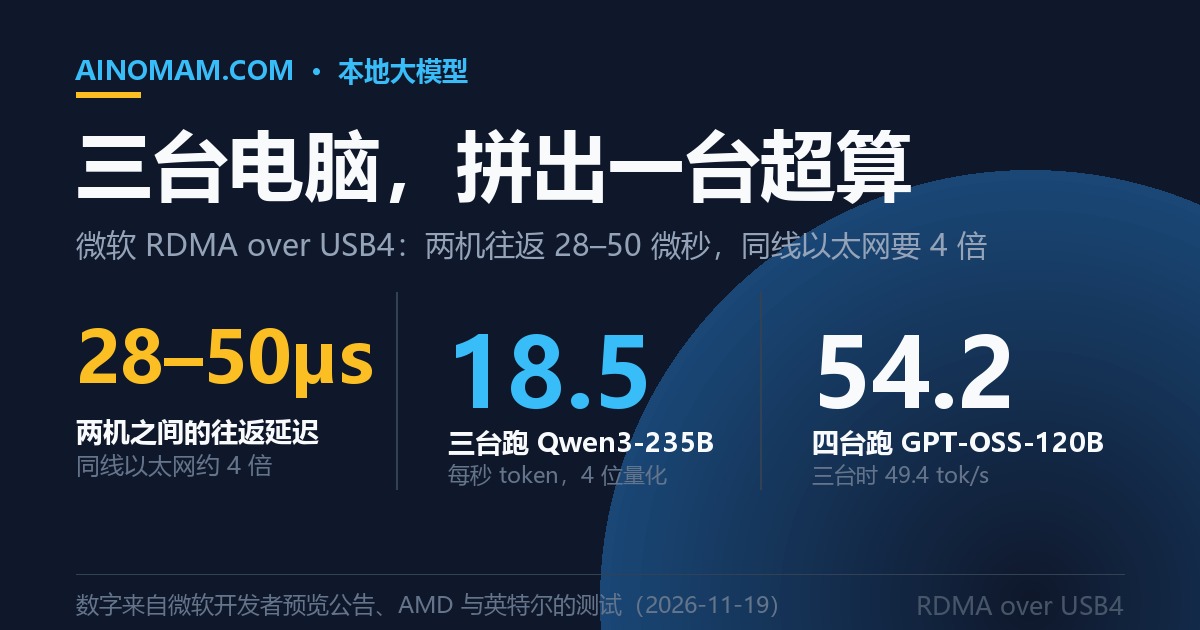
Microsoft's developer preview lets several Windows machines share memory directly over USB4 cables, so three mid-range PCs can pool RAM and GPU compute and run a 235-billion-parameter model. Measured round-trip latency between two machines is 28 to 50 microseconds; AMD and Intel have both demonstrated it on hardware you can buy.
📜 Table of Contents
📖 Keep reading
Three Ordinary PCs, One 235B Model: Microsoft's RDMA over USB4
Anyone trying to run a large model locally runs into the same wall. The GPU is usually fine. The memory is not. A model with hundreds of billions of parameters will not fit in one machine's RAM, and a purpose-built AI server costs more than most people will ever spend on a desk.
Microsoft's answer, shipped as a developer preview, is called RDMA over USB4. Connect two or more ordinary Windows PCs with USB4 or Thunderbolt cables and each machine can read and write the other's memory directly, pooling RAM and GPU compute across the whole group.
The acronym sounds intimidating; the mechanism is simple. Normally, when two computers exchange data, the bytes travel through the network stack: pack, unpack, copy, repeat, with the CPU handling the movement the whole way. RDMA skips all of it. One machine reaches into a registered memory region on another machine and reads or writes it in place.
【figure-1.png: three PCs pooling memory over USB4】
Until now this only existed in data centres, with dedicated network cards and InfiniBand switches. Microsoft's version is pure software. It reuses Windows' existing NetworkDirect interface, so any PC with a USB4 port can take part, and there is no special hardware to buy.
How fast is it, actually
In Microsoft's measurements, a small-message round trip between two directly connected machines takes 28 to 50 microseconds. Running plain Ethernet over the same USB4 cable is roughly four times slower. Latency is about the same at 40Gbps and at 80Gbps, which tells you the bottleneck here is latency, not bandwidth.
For browsing the web that number is meaningless. For inference it is the whole game. A large model exchanges data between machines several times for every token it generates, so latency sets the ceiling on how fast the model can talk.
【figure-2.png: latency comparison】
Two vendors already have it working
AMD connected three mini-PCs, each with a Ryzen AI Max+ 395 and 128GB of unified memory, in a full mesh over 40Gbps USB4, and ran Qwen3-235B-A22B at 4-bit quantization at roughly 18.5 tokens per second. AMD says its own decode measurement came out slightly higher. That model does not fit on a single one of those machines; three of them together were needed.
Intel ran GPT-OSS-120B across three or four Core Ultra Series 3 PCs. The model does not fit in a single 64GB machine either. Three machines produced 49.4 tokens per second; a fourth pushed it to 54.2.
One detail worth noting: Microsoft's own demo ran Qwen3-235B, so an open Chinese model ended up as the exhibit for a new Windows feature.
Three caveats before you buy anything
First, this is a developer preview. Ordinary users cannot turn it on yet.
Second, the wiring matters. Microsoft recommends a full mesh: with three machines, each needs at least two USB4 ports and you need three cables, every machine connected to every other. Daisy-chaining them noticeably drops performance.
Third, the software has to cooperate. An application must explicitly support distributed inference. You cannot install a chat app, double-click, and expect it to spread across machines.
What this is actually for
This targets people who already own two, three or four USB4 machines: developers and tinkerers. It will not replace a data centre, and it is not trying to. Nvidia's DGX Spark also supports linking four units, but that is a hardware business. Microsoft is putting the capability into the operating system, which means the machines already on your desk can theoretically become nodes.
The long-standing bottleneck for local large models has been memory capacity. This is a cheap way around it. How far it goes depends on how quickly inference frameworks such as llama.cpp pick it up.
Sources
- Microsoft Windows blog, "RDMA over USB4 on Windows" (2026-11-19, developer preview announcement)
- AMD's own test data (Qwen3-235B-A22B, Q4_K_M quantization, three Ryzen AI Max+ 395 mini-PCs)
- Intel's GPT-OSS-120B multi-machine test data
Written by our editorial team; tools listed here are tested or verified against public sources. Links point to official sites or GitHub repos for reference only — no paid placements.