Best Embedding Model for a 1 GB VPS: 62 MB to 522 MB
Small VPS deployments fail at the model download or the first OOM kill, because parameter counts hide the file size and the 256-token cap hides the truncation.
📜 Table of Contents
- The seven, measured
- How these numbers were collected
- What 1 GB actually leaves
- Model by model
- Three traps that decide the deployment
- What I would deploy
- FAQ
- Is 1 GB of RAM enough to serve embeddings?
- Do the scores survive int8 quantisation?
- Should I use an API instead?
- What about Chinese or mixed-language corpora?
- What this comparison does not cover
- Related
📖 Keep reading
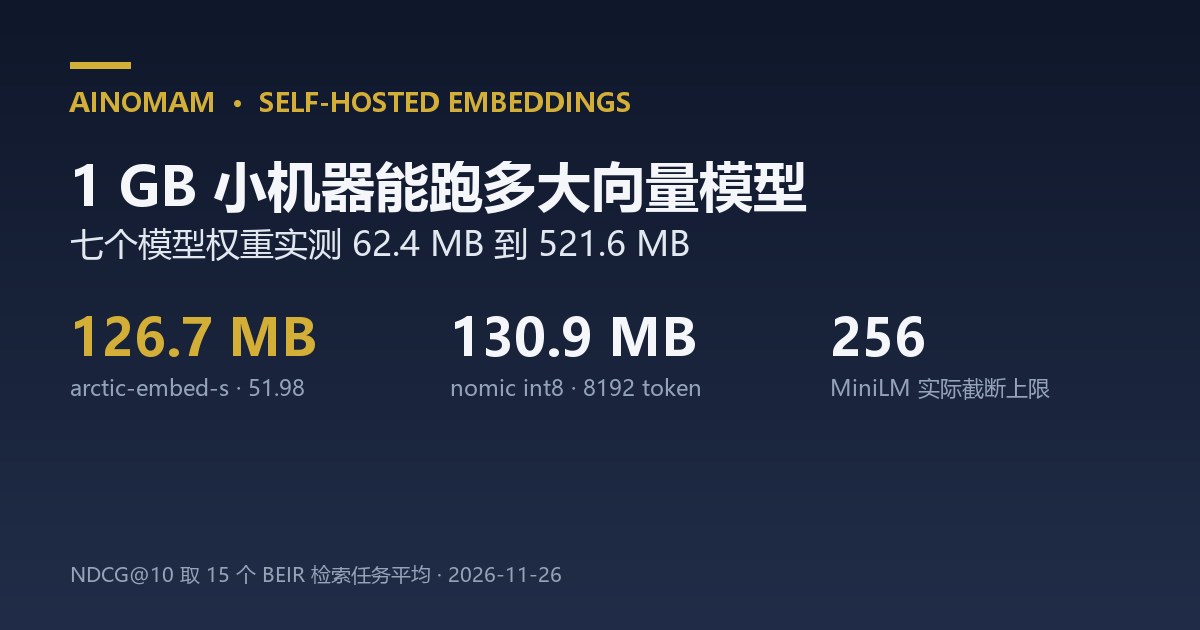
Seven embedding models, weight files measured on the Hub on 2026-11-26, from 62.4 MB to 521.6 MB. A 1 GB VPS can hold the first five with the runtime; the 448 MB and 522 MB models only fit in quantised form. The two best fits for English retrieval are Snowflake/snowflake-arctic-embed-s at 126.7 MB and BAAI/bge-small-en-v1.5 at 127.3 MB, with card-reported mean NDCG@10 of 51.98 and 51.68 over the same 15 BEIR tasks.
If your documents run past 512 tokens, the choice changes: nomic-embed-text-v1.5 accepts 8,192 tokens, scores 53.01 on that same 15-task average, and its int8 ONNX file is 130.9 MB, which fits where the 521.6 MB fp32 file does not.
The seven, measured
| model | weights | dims | max tokens | licence | Hub downloads | mean NDCG@10 |
|---|---|---|---|---|---|---|
| jinaai/jina-embeddings-v2-small-en | 62.4 MB | 512 | 8,192 | Apache-2.0 | 1.03M | 45.14 |
| thenlper/gte-small | 63.7 MB | 384 | 512 | MIT | 4.92M | 49.46 |
| all-MiniLM-L6-v2 | 86.7 MB | 384 | 256 | Apache-2.0 | 164.7M | not in card |
| snowflake-arctic-embed-s | 126.7 MB | 384 | 512 | Apache-2.0 | 45 thousand | 51.98 |
| BAAI/bge-small-en-v1.5 | 127.3 MB | 384 | 512 | MIT | 42.9M | 51.68 |
| multilingual-e5-small | 448.8 MB | 384 | 512 | MIT | 9.56M | 46.64 |
| nomic-embed-text-v1.5 | 521.6 MB fp32, 130.9 MB int8 ONNX | 768 | 8,192 | Apache-2.0 | 11.4M | 53.01 |
Every licence in the table permits commercial use. The size column is the actual model.safetensors file, not the parameter count times a guess.
How these numbers were collected
- Weight sizes: Hugging Face model API with blob sizes, read on 2026-11-26. Where a repository ships fp16 weights, that is what the file says; the ONNX variants are listed separately.
- Dimensions: hidden_size from each config.json. Maximum input: max_seq_length from sentence_bert_config.json, which is what sentence-transformers actually enforces.
- Quality: mean ndcg_at_10 over the 15 MTEB retrieval tasks that appear in all six cards that publish results, taken from each card's own model-index block. Not a benchmark run by this site.
- The comparison is approximate. bge and e5 expect query instructions or prefixes, and their published numbers assume those are used. Rerun on your own data before committing.
What 1 GB actually leaves
A 1 GB VPS does not hand you 1 GB. The kernel, sshd and package manager take roughly 150 to 250 MB, and a Python process with an inference runtime takes another 150 to 400 MB depending on whether you pulled onnxruntime or torch. That leaves a weights budget somewhere between 350 and 600 MB, and the reserved part is the part you cannot see until the OOM killer arrives.
Weights are file size: 62 MB model, 62 MB of RAM, plus activations that scale with batch size times sequence length. A batch of 32 chunks at 512 tokens costs far more memory in activations than a batch of 8.
Which is why the practical ceiling on a 1 GB box is a 130 MB file, not a 500 MB one. The 448.8 MB and 521.6 MB entries are there because their quantised variants are 112.9 MB and 130.9 MB, and because people do try the fp32 versions on small machines and then wonder why the process dies.
Model by model
snowflake-arctic-embed-s, 126.7 MB, 384 dims, 512 tokens. Best card-reported retrieval number in the small group at 51.98, Apache-2.0, 45 thousand downloads. The repository also ships int8 and fp16 ONNX builds at 32.4 MB and 63.7 MB, which is the version to run if your VPS is doing anything else at the same time.
BAAI/bge-small-en-v1.5, 127.3 MB, 384 dims, 512 tokens. One point behind at 51.68, MIT licensed, 42.9 million downloads, and the most documented of the group: query instructions, hybrid search with BM25, and reranker pairings all have published recipes. If you want to copy a known-good setup rather than experiment, this is the one.
nomic-embed-text-v1.5, 768 dims, 8,192 tokens. Highest score at 53.01 and the only model here that takes long inputs without truncation. The catch is 521.6 MB fp32 or 130.9 MB int8 ONNX, and 768 dims double the index size of a 384-dim model. It also expects task prefixes such as search_document: and search_query:, which its card spells out.
thenlper/gte-small, 63.7 MB, 384 dims, 512 tokens. The cheapest credible option: 49.46, MIT, 4.9 million downloads. Its card publishes 27 retrieval results, so the 15-task average is comparable with the rest.
jina-embeddings-v2-small-en, 62.4 MB, 512 dims, 8,192 tokens. Smallest file and the longest input window outside nomic, but the weakest retrieval average here at 45.14. Worth it when RAM is the hard constraint and documents are long; not worth it for a short-chunk English index.
multilingual-e5-small, 448.8 MB, 384 dims, 512 tokens. The only multilingual option in this set that can be squeezed onto 1 GB in int8 at 112.9 MB. English retrieval average of 46.64 does not tell you much if you need five languages; that is the trade.
all-MiniLM-L6-v2, 86.7 MB, 384 dims, 256 tokens. 164.7 million downloads, more than everything else here combined, and no MTEB retrieval block in its card, so it has no number in the table. The 256-token cap is the real cost: a 512-token chunk is silently truncated, and half of it never gets embedded.
Three traps that decide the deployment
- The token cap is not the context window you think. MiniLM ships max_seq_length 256 in sentence_bert_config.json even though its config.json says 512 positions. Chunk at 512 and the model quietly embeds the first half.
- Dimensions cost disk forever. 384 dims means 1,536 bytes per vector in float32, 768 means 3,072. At a million chunks that is 1.4 GiB against 2.9 GiB before any index overhead, and the RAM you saved by picking a small model goes straight back into the index.
- Prefixes are part of the model. e5 wants query: and passage: prefixes, nomic wants search_document: and search_query:, bge performs better with its query instruction. Skip them and the published scores do not apply to your system.
What I would deploy
- English, 512-token chunks, 1 GB box: snowflake-arctic-embed-s. Best number in the class, 126.7 MB, and an int8 build at 32.4 MB if the box is shared.
- English, need published recipes and reranker pairings: bge-small-en-v1.5, 127.3 MB, MIT.
- Anything past 512 tokens: nomic-embed-text-v1.5 int8, 130.9 MB, 8,192 tokens, best score here. Budget the index for 768 dims.
- Five languages on the same box: multilingual-e5-small in int8, 112.9 MB.
- Under 100 MB of free RAM: gte-small at 63.7 MB is the only one here that keeps a credible score, 49.46.
FAQ
Is 1 GB of RAM enough to serve embeddings?
For a small model, yes, at low concurrency. The arithmetic: 150 to 250 MB for the OS, 150 to 400 MB for the runtime, 62 to 130 MB for the weights. That leaves room for a modest batch, not for four workers each loading their own copy. One process, one model, is the rule on a box this size.
Do the scores survive int8 quantisation?
Not measured here. The 51.98, 51.68 and 53.01 figures are the fp32 numbers published in the model cards. Quantisation costs some retrieval quality; the only honest way to size that cost is to embed a few thousand of your own chunks both ways and compare recall at k.
Should I use an API instead?
If you have fewer than a few million chunks and no privacy constraint, a hosted embedding endpoint removes the RAM question entirely and costs a fraction of a VPS you have to babysit. Self-hosting wins when the corpus is large, the data cannot leave the box, or you need a model nobody hosts.
What about Chinese or mixed-language corpora?
bge-small-en-v1.5 and the other English models in this table are English-only. For Chinese use a multilingual model: multilingual-e5-small at 448.8 MB fp32, or bge-m3 if you have the RAM for 2.27 GB. Token counts also rise: a Chinese page costs noticeably more tokens than the same content in English under most encoders.
What this comparison does not cover
Throughput. File size is a proxy for RAM, not for speed: a 384-dim model with 6 layers will embed far faster than a 768-dim model on two vCPUs, and no card publishes tokens per second on the hardware you actually rent. Measure that on your box with a hundred of your own chunks before you commit, and measure after quantisation.
Related
- One million chunks: 1.4 GiB or 15.4 GiB - what 384 against 768 dims does to the index.
- Weaviate vs Vespa in Docker - the 4 GB wall that decides whether a VPS can host the vector store as well.
- RAG chunking strategies - chunk size decides whether a 512-token model is enough.
Written by our editorial team; tools listed here are tested or verified against public sources. Links point to official sites or GitHub repos for reference only — no paid placements.