DDR6 Specs Preview: 12,800 MT/s at the Start
JEDEC's DDR6 spec preview puts the entry speed at 12,800 MT/s and shortens the module from 133 mm to 74 mm. Here is what each number means, and what the standard still leaves open.
📜 Table of Contents
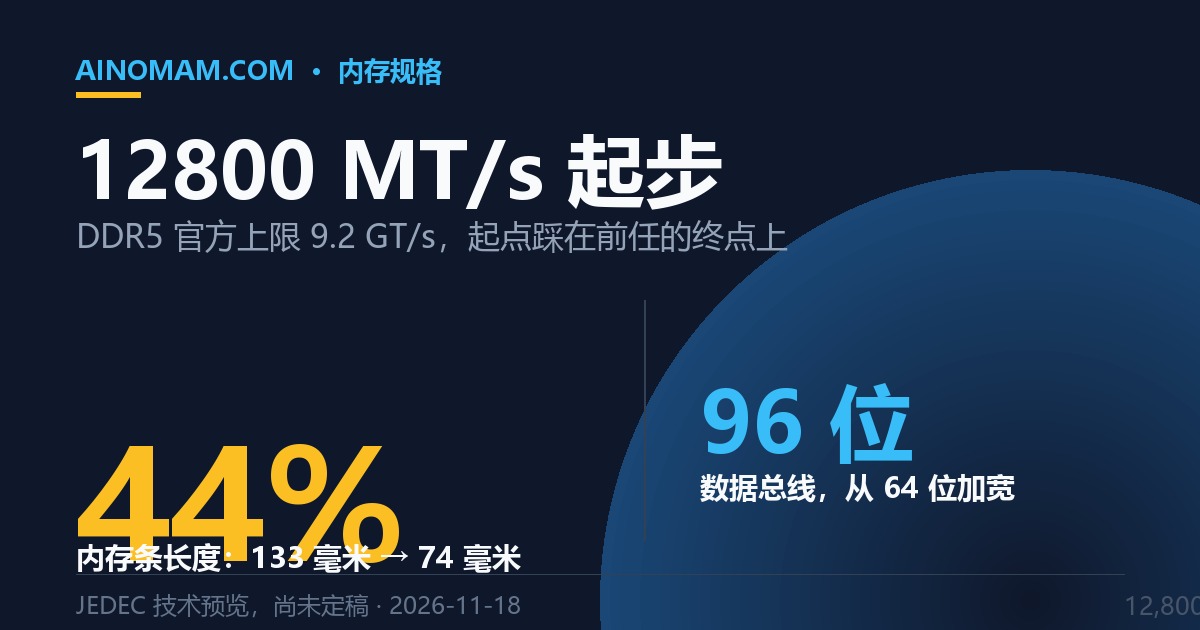
On November 18 JEDEC published its DDR6 memory specification preview. Two changes matter: one in a number, one in a ruler. The number is speed — 12,800 MT/s at the start, with a roadmap to 14,400. The ruler is length — 133 mm down to 74 mm, a 44% cut.
First, what this document is. JEDEC released a technical preview, not a final standard. The document says so plainly: the published parameters are development planning, they can still change during approval, and the board can decline to ratify them at all. Every number below is "what they currently intend to do".
The name sounds obscure, but the thing it governs sits in every desktop. How fast, how wide and how long the memory sticks in your machine can be is settled by this committee: Samsung, SK hynix, Micron, Intel, AMD, more than four hundred companies at one table.
Speed: the entry point sits on DDR5's ceiling
DDR6 RDIMM starts at 12.8 GT/s, which is 12,800 MT/s. The official ceiling for DDR5 at that tier is 9.2 GT/s. The starting point is nearly 40% above where the previous generation finishes.
Consumer parts are the more interesting case. DDR5 UDIMMs stop at 4800 in the official spec; the 8000 and 9000 kits on sale today are binned dies pushed past it, a point Wccftech made when it assembled the comparison table. DDR5 took five years to reach that ceiling. DDR6 stands on it at launch.
The speed comes from a rewritten interface: the data bus goes from 64 bits to 96, 50% wider; internal banks double; a single channel is split into pseudo-channels so one DRAM package can carry more bandwidth. JEDEC's own line is that together these add more than 50% bandwidth the moment the standard lands.
JEDEC also wrote a sentence saying 50% more bandwidth does not mean 50% more application performance. They put that in on purpose, which tells you what they expect the coverage to say. Keep it, because someone will treat a bandwidth figure as a performance promise.
One note for gamers: games have been fed on bandwidth for a while. The graphics card's path is far wider; frame rates are held back by latency and capacity. The first real beneficiaries of this interface are integrated GPUs and locally run AI models. JEDEC gave no latency numbers this time, so that waits for silicon.
Length: this one does not come back
133 mm becomes 74 mm. That is 44% shorter.
The module has kept its size since the DDR era, more than twenty years with little movement. Cutting it nearly in half is not about looks or small cases. At 12.8 to 14.4 GT/s, signals reflect on copper, impedance goes out of control, and the longer the trace from the DRAM package to the CPU's memory controller, the more likely it fails. Shortening the module shortens the traces and rescues signal integrity.
The cost is that board layout changes completely. In the same area, 74 mm modules fit more of themselves, which helps servers and means another design for desktops.
Form factor: the DIMM may not survive
JEDEC says DDR6's form factor is still being defined and may include RDIMM, UDIMM and CAMM. CAMM is a compression-attached module already used in laptops for several generations; it is not a slot. If DDR6 goes that way, the routine desktop users have had for twenty years — open the side panel, press the clips, swap a stick — stops being routine.
There is no insider information here, and no claim that the DIMM is dead. But a 74 mm module with a 96-bit bus and a compression connector does move further from "upgrade it yourself" and closer to "configured at the factory, sold by SKU". Apple finished that road years ago; laptops are most of the way down it.
The centre of gravity is not on the desktop
DDR6 switches to a VSS-terminated I/O and adds a low-power mode aimed at data centres. JEDEC lists its scenarios as AI inference, agentic AI, cloud computing and high-capacity memory close to the CPU. Every optimisation in the document leans toward the machine room. Consumers get the benefits as passengers; the force pushing the standard forward is not in a gamer's graphics budget.
Timing: not a word
JEDEC gives no production date. DDR5 followed a known rhythm: the first spec in 2020, consumer parts actually buyable in late 2021, more than a year apart. DDR6 is still in preview; ratification, tape-out, platform support and pricing put it at least three to four years out, and five does not feel conservative.
So wondering whether to wait for DDR6 has no practical answer. The machine on your desk will most likely not last until DDR6 is cheap.
Half the value of this story is 12,800. The other half is 74 mm. The speed decides how fast memory runs for the next few years; the size decides whether you can still install it yourself.
Right now 74 mm is one line in a specification table. By the time it is the machine on your desk, it will feel different.
Written by our editorial team; tools listed here are tested or verified against public sources. Links point to official sites or GitHub repos for reference only — no paid placements.