Headcanon Generator: Template or AI? 6 Sites Compared
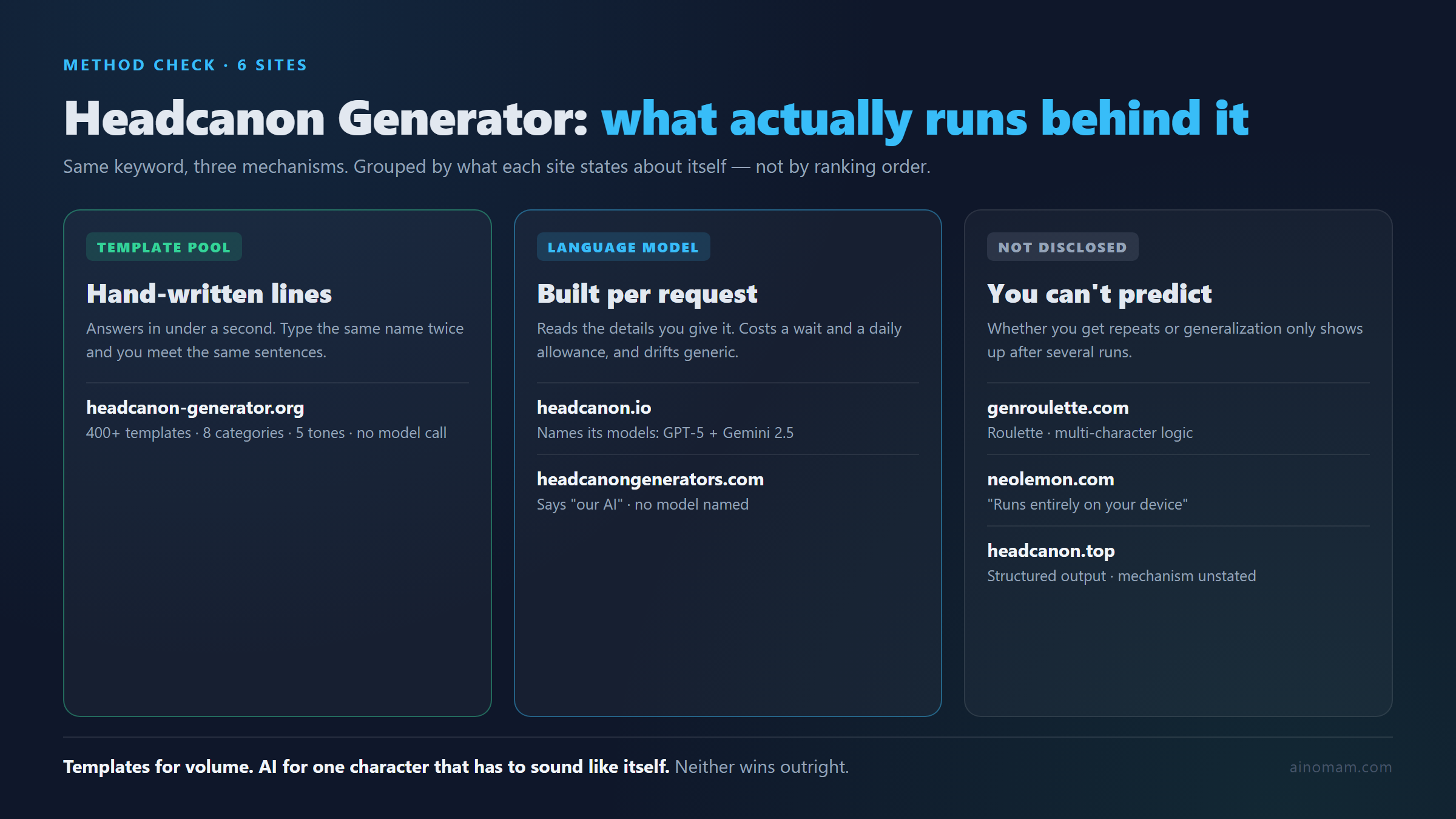
Six sites rank for this keyword and they do not work the same way. One says outright that it runs on 400+ hand-written templates instead of a language model. Two say they call a model, and one of those names GPT-5 and Gemini 2.5. The remaining three do not say, or only say it runs in your browser.
That difference decides what you get. Templates answer in under a second but hand you the same lines the next time you type the same name. AI adapts to the character you describe, at the cost of a wait and a daily allowance. Pick templates when you need volume and do not mind repeats; pick AI when you need one specific character to sound like itself.
💡 What You Will Learn
Six sites rank for this keyword and they do not work the same way. One says outright that it runs on 400+ hand-written templates instead of a language model. Two say they call a model, and one of thos
📜 Table of Contents
- Why the mechanism decides everything
- The six, by what they actually run on
- Template-based — headcanon-generator.org
- Wheel-based — genroulette.com
- AI, named — headcanon.io
- AI, unnamed — headcanongenerators.com
- On-device — neolemon.com
- Undisclosed — headcanon.top
- Three tests for any line you get
- What none of the six does
- Common questions
Headcanon Generator: Template or AI? 6 Sites Compared
A headcanon is only worth keeping if it is specific. "Brave and loyal" is a character sheet. "Apologizes for things that aren't their fault, then gets annoyed when you point it out" is a headcanon. The six sites ranking for this keyword differ less in design than in what produces the sentence — and that is what decides whether you get the second kind or the first.
Why the mechanism decides everything
Template-based generators ship a fixed pool of hand-written lines and slot your character name in. The output is grammatical, in character-adjacent territory, and instant — but it cannot respond to anything you say about the character beyond the name. Ask twice and you meet the same lines again.
AI generators build each line on the spot. They read whatever details you give them, so an OC with a stated fear gets different material than a canon character with no context. The cost is latency, an allowance, and a tendency toward the same vaguely wholesome register every model defaults to.
Neither is better. They fail differently. Templates fail by repeating; AI fails by generalizing.
The six, by what they actually run on
Template-based — headcanon-generator.org
This is the only site on the first page that states its mechanism plainly, and it states it as a selling point: 400+ hand-written templates across eight categories (personality, daily life, relationships, secrets, skills, fears, favorites, quirks) and five tones, no credits, no queue, no model call. The author writes in first person and complains about competitors being ChatGPT wrappers, which is at least a position.
The tradeoff is exactly the one described above. The templates are good — the writing has a voice — but they cannot read your character. What you get is a well-written line with a name in it.
Best when you need ten options fast and can judge them yourself.
Wheel-based — genroulette.com
A roulette rather than a prompt box. The interesting part is multi-character handling: enter two names and it prioritizes joint situations and interactions, which is the right shape for ship and rivalry prompts. Free, no account, no captcha, and it exports cards as PNG sized for TikTok, Tumblr and Instagram.
Single-character depth is thinner than the pure text generators. If your use case is "give me a scene for these two," this is the fastest route.
AI, named — headcanon.io
The only site that names its models: GPT-5 and Gemini 2.5 integration. Free tier with premium features above it, plus two things the others lack — a live stream of headcanons other users generated, and AI character images alongside the text.
The community stream matters more than it sounds. Seeing what other people roll tells you the output distribution before you spend a turn. The AI character images are a separate feature and should be treated as such, not as evidence about the text quality.
AI, unnamed — headcanongenerators.com
Currently first for the keyword. Says "let our AI create your character's headcanon," free with no stated limit, optional account to save results. Covers characters, OCs and ships, and links out to an OTP prompt generator for romantic pairings.
The page is the thinnest of the six in substance — roughly 1,200 words, most of it explaining what a headcanon is rather than how to use one. It ranks on domain match and a clean tool-first layout, not on depth.
On-device — neolemon.com
Advertises five categories, unlimited rolls, and — the distinguishing line — the generator "runs entirely on your device," with no quota and no wait. Per-card reroll is the useful detail here: you can reroll one result without regenerating the rest, which is how you actually iterate.
Running on-device means either a small model or a template pool. Either way, expect less adaptation to character detail than a hosted model gives you.
Undisclosed — headcanon.top
Single-character tool with a homepage teaser and a fuller generator one click in. The output is the most structured of the six: premise, emotional logic, expandable details, scene energy, rather than one paragraph.
The mechanism is not stated anywhere on the page. That is not disqualifying, but it means you cannot predict whether you will get repeats or generalization until you have run it several times.
Three tests for any line you get
Run every output through these before it goes near a draft.
One: is it an observable behavior? If the line could describe any protagonist in the genre, it is a label, not a headcanon. Rewrite it as something the character does when nobody is watching.
Two: does it sit slightly against canon? Fully consistent details are character sheets. Headcanons live in the space canon left open, and the good ones create mild friction with what is established — plausible enough to accept, off enough to be interesting.
Three: can it grow into a scene? If you can see the next beat, keep it. If it terminates in itself, it is a fortune cookie.
A generator that fails all three is not broken — it is doing what its mechanism allows. Your job is the filter.
What none of the six does
No site on the first page gives worked examples for a specific fandom. Every one of them explains what a headcanon is in the abstract and then stops. Nobody shows you ten headcanons for a named character from a named series and explains which ones work and why.
Nobody addresses the thing this audience actually worries about: that an AI-generated line is recognizable as AI in a Tumblr thread or an AO3 comment section. There is no guide to editing the output until it stops sounding generated.
And TTRPG use — NPC backstory at the table, which is a large share of the search demand — gets one sentence across all six pages combined.
Those three gaps are what the rest of this series covers.
Common questions
Is a headcanon generator free? All six have a free path. Two limit output or gate features behind an account, one (headcanon.io) has a premium tier, and headcanon-generator.org and neolemon.com both advertise unlimited use with no signup.
Does it work for canon characters and OCs? Yes, but differently. Canon characters carry context the tool may or may not use; OCs depend entirely on how much detail you provide. The less you type, the more generic the output, regardless of mechanism.
Can I use it for D&D or Pathfinder NPCs? Yes, and the template-based sites are better for it than the AI ones — you want eight rough hooks to pick from at the table, not one polished paragraph that takes twenty seconds to generate.
Which one should I use for fanfiction? Whichever you can filter. The mechanism matters less than whether you are willing to reject most of what comes back.
Written by our editorial team; tools listed here are tested or verified against public sources. Links point to official sites or GitHub repos for reference only — no paid placements.
