Rockstar Hasn't Shipped GTA6 on PC. AI Coded a Port in Three Days
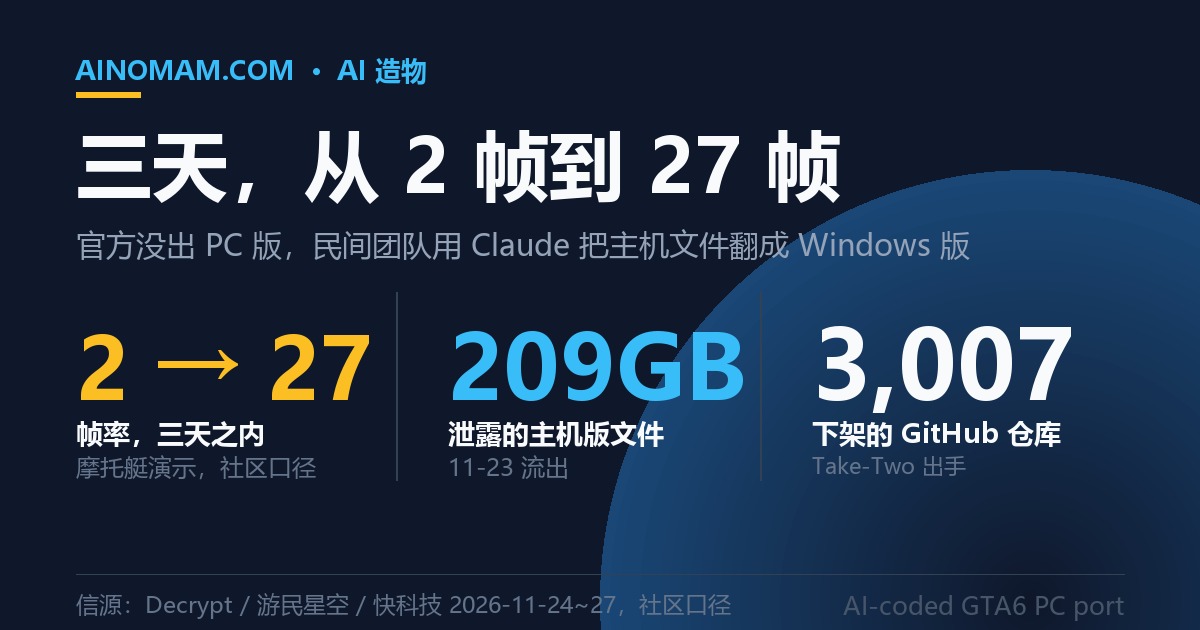
Rockstar has not shipped a PC build, yet a community port went from 2 fps to 27 fps in three days with Claude parsing crash logs. The speed leaves three problems: stability, malware, and takedowns.
📜 Table of Contents
📖 Keep reading
Short version: Rockstar has not shipped a PC build, yet a community port of GTA6 already runs, and it went from 2 fps to an average of 27 fps in a matter of days. What pushed it along was not a wizard programmer. It was AI.
It started on November 19
GTA6 launched on November 19 for PS5 and Xbox, locked at 30 fps. PC players asked Rockstar for their version and got silence, the same silence that followed GTA5, whose PC release took another year and a half.
On November 23 a hacker going by Cyberleek dumped the Xbox build's main executable, more than 200GB in all. He first used it to pump a memecoin of his own, promising to release the files once the token reached a $15 million market cap. The token did not get there. The files came out anyway.
How a port works
Once the files were loose, porting teams started at the same time. A port translates a console build into something Windows can run. The fastest route was a compatibility layer called Victory: rather than rewriting game code, it translates Xbox system calls down to Windows a layer at a time, leaving the game data untouched. Asset packages spread through P2P sites within days.
Three days, 2 fps to 27 fps
At the start the picture ran at 2 fps with graphics errors across the screen. Three days later a team posted footage of driving a jet ski: water reflections, clouds, the distant bridge, minimap and subtitles all working, frame rate steady between 25 and 30, averaging 27. The test rig was a Ryzen 7 9800X3D with an RTX 5070 Ti and 32GB of RAM.
The reason for the speed shows up in telemetry and in what the developers say: heavy use of tools like Claude to parse crash logs, locate faults and patch code directly. The practice has a name, vibe coding. The human talks, the model types. Debugging that used to take months collapsed into days, and a livestream of the recompile drew 70,000 concurrent viewers.
Specs surfaced too: a six-core 4.5GHz CPU, 24GB of RAM and an RTX 2060 at minimum; eight cores, 32GB and an RTX 3080 recommended. Running an unoptimized port on an RTX 2060 is not a low bar.
Three buckets of cold water
First, the experience is rough. The frame rate swings between 5 and 30, with crashes, VRAM overflows and driver failures as routine. Every demo so far is shot in open water, a low-load scene. Nobody has shown what downtown looks like with tall buildings in view.
Second, safety. Files from asset sites carry a real chance of malware, and the machine that installs one may end up mining for someone else.
Third, legal. Take-Two has moved: GitHub took down 3,007 related repositories in one sweep and several well-known port projects shut down. Reverse engineering of this kind does not hold up in law.
The part that matters
The story here is not piracy. It is the tempo of AI-assisted work. Months of debugging compressed into days is not a script unique to GTA6. Whether Rockstar's official PC build gets pulled forward by the community's progress is a separate question. What is already settled is that feeding a pile of crash logs to a model and letting it patch the code works.
If you want to play it on PC, wait for the official release.
Sources
- Decrypt (2026-11-26): AI-assisted porting, Claude vibe coding, Take-Two's takedown of 3,007 GitHub repositories, the Cyberleek memecoin episode
- Gamersky (2026-11-27): community GTA6 PC port released, system requirements published (via PCMrace)
- Kuaikeji (2026-11-26): GroupBoYoo jet-ski footage, 9800X3D + RTX 5070 Ti, 27 fps average
- Sina Tech (2026-11-26): GTA6 PC build appears on asset sites, 25-30fps
- NetEase / Gamersky (2026-11-24): Project Leonida, version 1.0.2.1 files at 208GB (a 209GB figure also circulates), 350GB of space needed to port
Written by our editorial team; tools listed here are tested or verified against public sources. Links point to official sites or GitHub repos for reference only — no paid placements.