AI Cloze Items: 17 of 90 Accept a Second Answer
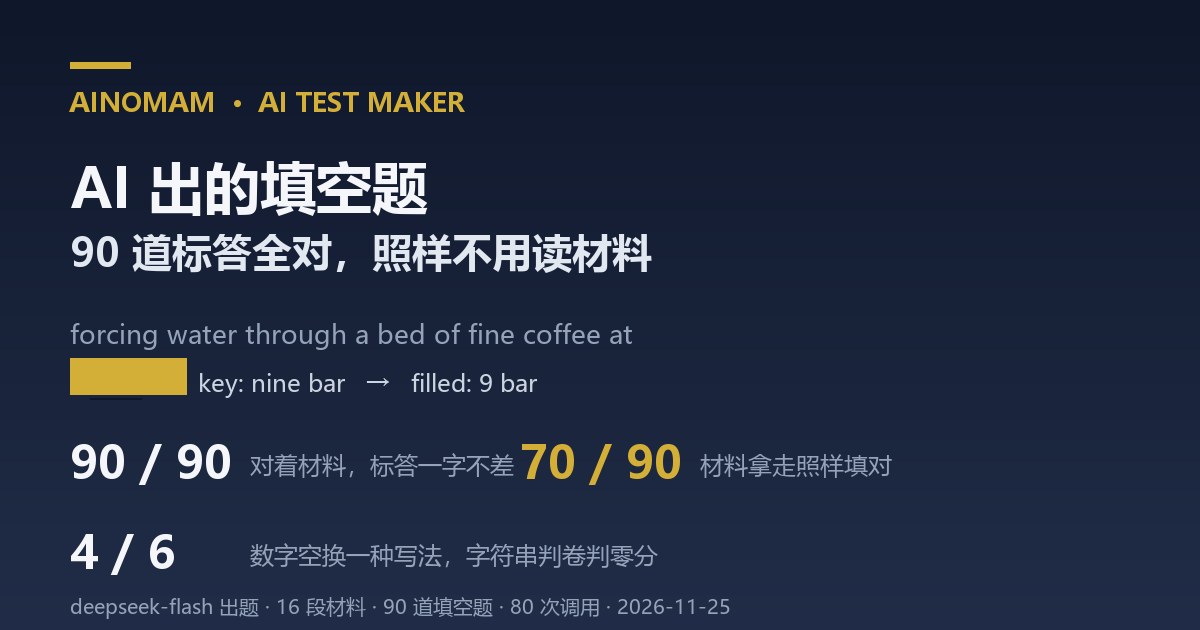
A cloze quiz from an AI test maker has an exact, reproducible answer key, and most of its blanks can still be filled with the passage shut, so the format grades cleanly and measures very little.
📜 Table of Contents
📖 Keep reading
A fill-in-the-blank quiz is the format a teacher reaches for when the answer has to be a single word, and it is the one format where an AI's answer key can be settled without argument. I ran 90 items through it. Given the passage, two different models reproduced the key on all 90, character for character. No item repeated its own answer elsewhere in the sentence. No blank landed on "the" or "of". Every blank was written as four underscores, so the width of the gap told the student nothing about the word behind it.
Then I removed the passage. Seventy of the ninety blanks were still filled correctly: 53 with the exact key, 17 with different wording a teacher would accept. The format fixes the key and leaves the reading problem alone.
How the run was built
Sixteen passages from the corpus the earlier runs in this series used, ten in English (sourdough, ice cores, cable-stayed bridges, paper sizing, honey, railway ballast, espresso, satellite drag, blade erosion, first crack) and six in Chinese (点茶, bridge expansion joints, railway switches, soy sauce, optical fibre, saline soil). Six items per English passage, five per Chinese one, 90 items, one call per passage, deepseek-flash at temperature 0.8, 21,339 tokens.
The prompt was the plain one, with no instruction about which word to blank: take a sentence from the passage, replace one word or a short phrase with ____, return the sentence and the answer as JSON. Everything below is what that prompt produces, not a tuned version of it.
Three fill passes ran at temperature 0, one call per passage each: the same model with the passage, deepseek-chat with the passage, and the same model with the passage withheld. A judge then read the 37 blanks that came back as something other than the key, with the passage and the sentence in front of it, and decided whether a teacher would mark them right. 80 calls, 99,042 tokens, 73 seconds for the first two stages.
The key is exact, both times
| fill pass, temperature 0 | result |
|---|---|
| deepseek-flash, passage shown | 90 of 90 matched the key |
| deepseek-chat, passage shown | 90 of 90 matched the key |
| deepseek-flash, passage withheld | 53 of 90 matched exactly |
| passage withheld, other 37 judged | 17 accepted as a correct wording |
| filled correctly without the source | 70 of 90 |
Every one of the 90 answers appears verbatim in its passage, and 74 of them appear exactly once, so the key has a single source and no second candidate. That is a property of how the item is made: a sentence already in the source, with a hole cut in it. It is also why the answers held up in a run where the multiple-choice distractors did not and the true/false statements were answerable from general knowledge.
Two failures that keep turning up in the other formats did not appear. No item gave its own answer away elsewhere in the sentence, 0 of 90. No blank sat on a function word, 0 of 90. Each blank came out as exactly four underscores, 90 of 90, so the gap never encoded the length of the missing word.
What the item actually is
Set the key back into the blank and 79 of the 90 items are the passage sentence word for word: 57 of the 60 English items, 22 of the 30 Chinese ones. The other 11 are fragments cut out of a longer sentence, three English and eight Chinese, and seven of those end with no punctuation at all, two of them on a semicolon mid-thought. Nothing is paraphrased. The item is a citation with a hole in it, and no sentence was used twice inside a passage.
What the hole removes is better than I expected.
| what the blank removes | items |
|---|---|
| domain term or multi-word technical phrase | 46 |
| common noun | 19 |
| adjective | 10 |
| verb | 8 |
| number | 6 |
| other | 1 |
46 blanks on a domain term or a multi-word technical phrase, 19 common nouns, 10 adjectives, 8 verbs, 6 numbers, one on something else. Nothing landed on a glue word. For a cloze test meant to check vocabulary in context, that is close to what a teacher writes by hand.
Take the passage away: 70 of 90
The blind pass is where the format shows its limit. 53 blanks came back with the exact key and no passage in the prompt. Of the other 37, the judge accepted 17 as a correct answer in different words.
| sentence | key | filled with the source withheld | judged |
|---|---|---|---|
| A sourdough starter is a ____ of wild yeasts and lactic acid bacteria. | culture | symbiotic culture | correct |
| A cable-stayed bridge carries its deck on ____ running from the deck up to one or two pylons. | inclined cables | cables | correct |
| An espresso shot is brewed by forcing water through a bed of fine coffee at around ____. | nine bar | 9 bar | correct |
| 宋代点茶先把茶饼碾成细末,放进预热过的 ____ 里 | 盏 | 茶盏 | correct |
| 光纤里的光脉冲会 ____,原因有两个。 | 变宽 | 展宽 | correct |
| Bakers control the balance with ____, temperature and time. | feeding ratio | hydration | wrong |
| Antarctic cores drilled to ____ reach ice older than eight hundred thousand years. | three kilometres | bedrock | wrong |
| 可动心轨让辙叉的心轨能够贴靠 ____,把这段空隙消除掉。 | 基本轨 | 翼轨 | wrong |
| 地下水通过毛细作用上升到表层,年复一年就结成白色的 ____。 | 盐壳 | 盐霜 | wrong |
Seventeen is a floor, not a ceiling. Two of the twenty the judge rejected read fine to me, 盐霜 for 盐壳 and 加剧 for 加速, and a marker working from the passage would probably take both. Counting only what the judge accepted, 70 of 90 blanks (78%) can be filled without reading the source.
The reason is visible in the sentences. A copied sentence carries its own context: "forcing water through a bed of fine coffee at around ____" has one plausible fill in the world, passage or no passage. The blanks the blind pass handles badly look like this: 基本轨 against 翼轨, feeding ratio against hydration, where the sentence points at a term and does not contain it.
Where the string match fails
Six blanks removed a number. Four of those six came back, when filled without the passage, as the same number in another notation, and the judge accepted all four:
| key | the same number, filled without the source |
|---|---|
| nine bar | 9 bar |
| thirty-six grams | 36 grams |
| six hundred kilometres | 600 kilometres |
| ten point seven | 10.7 |
Send those four through a platform that compares the student's string with the key and every one of them scores zero. This is the failure that belongs to this format: not a bad key, not a guessable item, a right answer written differently. The key is generated as words, the class writes digits, the marking is wrong, and nobody notices, because the item looked fine.
The prompt that survives this
Three additions to the plain prompt, each tied to a number above.
Numbers go in digits in the sentence and in the key, and the key lists accepted variants: "9 bar; nine bar". Without that, 4 of the 6 number blanks split across two notations.
Every blank must sit on a figure, a name, or a term that appears only once in the passage: 74 of 90 answers appeared once, and the six blanks that removed a number were the hardest to fill blind, five of the six wrong. A blank the class can fill without the passage is a blank that never tested the passage.
Ask for the sentence to be rewritten rather than copied, and require a complete sentence with its terminal punctuation: 7 of the 90 here came back unfinished. Then run the blind pass and delete anything answered correctly with the source withheld. That removed 70 of the 90 here, so the item pool has to be three times the size of the quiz you want to end up with.
What this run does not show
Sixteen passages I wrote myself, on subjects the model already knows. One model family generated the items and judged them; a different judge would move the 17. One blind draw per item, so the 53 is a point estimate with no error bar. Chinese answers were one to three characters, which makes exact matching harsher there than in English. No student sat these items; the blind pass measures what a model reconstructs from context, which is a proxy for what a class guesses, not the same measurement.
What does carry: 90 of 90 keys reproduced by two models with the passage shown, 70 of 90 blanks filled correctly without it, and 4 of 6 number blanks that take a second notation your string match will not. The nine free makers these prompts go into are compared in the free test maker comparison, where the answer key is the thing being judged. The format before this one had the opposite problem, 49 of 60 multi-select items keyed to A and B: the multi-select answer positions. The six checks that catch items no student can fail are in the six-check gate, and the table version, where 60 items were 60 copied cells, is in the table run.
A second wording still grades when a human reads it. A LaTeX brace does not survive the import at all: 34 of 60 formula items were cut off before their first option: the formula run.
Same corpus, same question: cloze kept 70 of 90 answers with the passage shut, and a matching set built from the same passages kept 75 of 75. A blank is selected by the sentence; a definition is selected by the term: the matching run.
Written by our editorial team; tools listed here are tested or verified against public sources. Links point to official sites or GitHub repos for reference only — no paid placements.