AI Matching Items: 75/75 Pairs Matched With No Passage
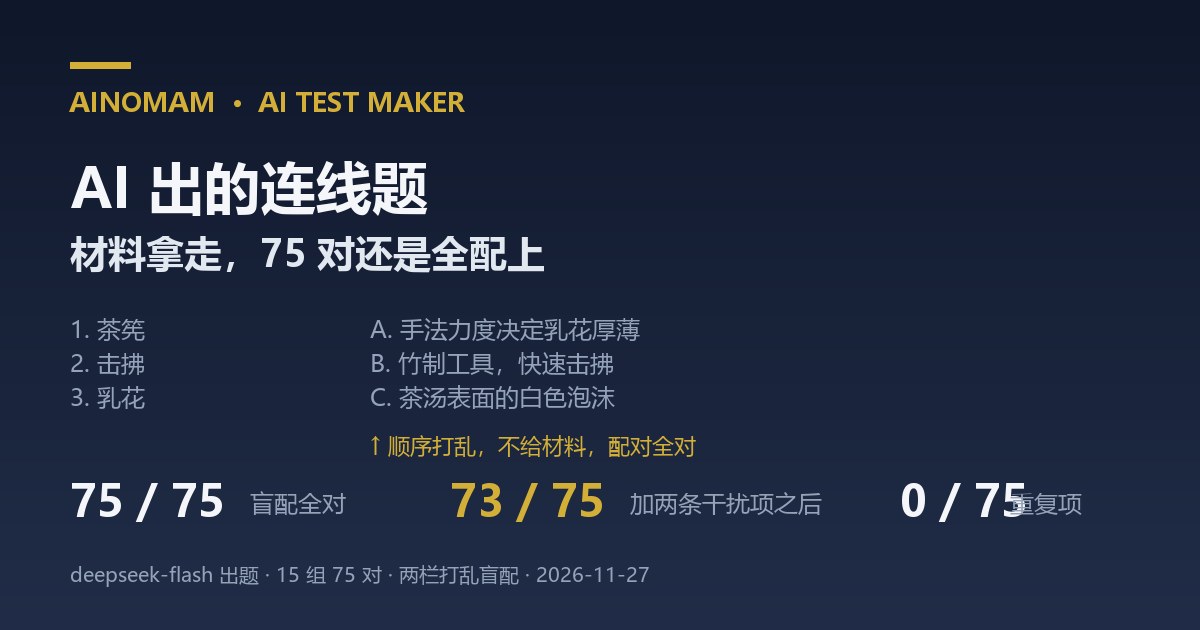
A matching quiz from an AI test maker looks rigorous and grades cleanly, but a model given only the two shuffled columns, with the passage withheld, pairs every item correctly.
📜 Table of Contents
📖 Keep reading
A matching question is the format that looks like it checks whether the reading happened: a term on the left, a definition on the right, two columns shuffled, the student pairs them against the passage. I ran fifteen sets through an AI test maker, five pairs each, seventy-five pairs in all. The result splits in two, and the good half is not where I expected it.
The structure held up. Not one duplicate term in seventy-five left-column entries, not one duplicate definition in the right column, and all seventy-five terms appear verbatim in the passage they were drawn from. Right-column length sits between eight and thirteen words in English and between fourteen and twenty-one characters in Chinese, so the length cue that leaks answers in multiple-choice items has nothing to work with here. Those are the failures this series kept finding elsewhere; this format passed all of them.
Then the passage came out. Shuffle the right column, hand over two columns and nothing else, and the seventy-five pairs come back complete: seventy-five of seventy-five. Add two extra definitions drawn from the same passage, seven right-hand items against five on the left, and it still returns seventy-three of seventy-five. A matching question does not measure whether the passage was read. It measures whether the term is already known.
How it was run
- Fifteen passages from the corpus this series has been using: ten English (sourdough, ice cores, cable-stayed bridges, paper sizing, honey, railway ballast, espresso, satellite drag, blade erosion, first crack), five Chinese (whisked tea, bridge expansion joints, railway turnouts, soy sauce, optical fibre).
- One call per passage, deepseek-flash at temperature 0.8, five pairs requested, with an explicit instruction that every left-column term must appear verbatim in the passage. Fifteen calls, 14,241 tokens.
- Blind pairing: the right column was shuffled with a fixed seed and both columns were handed to the same model with no passage and temperature 0.
- Distractor arm: fifteen more calls asked for two terms from the same passage that were not already used, with definitions in the same shape. Those were appended, the column was shuffled, and the five-against-seven pairing ran the same way.
- Sixty calls, 45,179 tokens, sixty-six seconds of wall clock, all on 2026-11-27.
The structure came back clean
| check | result |
|---|---|
| duplicate terms in the left column | 0 of 75 |
| duplicate definitions in the right column | 0 of 75 |
| terms that appear verbatim in the passage | 75 of 75 |
| right-column length, English | 8 to 13 words |
| right-column length, Chinese | 14 to 21 characters |
| sets with equal column sizes | 15 of 15 |
Duplicate columns are what breaks a matching question in practice, and they are the first thing a teacher should count: two identical definitions on the right make two pairings correct at once, and the item cannot be graded. Zero in seventy-five here, in both columns. The instruction to keep terms verbatim was followed on every one of the seventy-five, so nothing was invented and nothing needs a source check afterwards.
The length parity is worth a sentence because it is the opposite of what multiple-choice items do. There, the correct option tends to run longer than its distractors and students learn to bet on it. Here every definition was compressed into the same shape: eight to thirteen words, fourteen to twenty-one characters. Nothing to bet on.
Seventy-five of seventy-five with no passage
| arm | columns | pairs recovered with no passage | sets fully solved |
|---|---|---|---|
| English, 10 sets | 5 left / 5 right | 50 of 50 | 10 of 10 |
| Chinese, 5 sets | 5 left / 5 right | 25 of 25 | 5 of 5 |
| English and Chinese, 2 extra right items | 5 left / 7 right | 73 of 75 | 13 of 15 |
Seventy of the seventy-five came back as plain text, most of them prefixed with the letter of the item they picked; one Chinese set of five answered in bare letters, and those mapped through the shuffled order to the right five. Only two pairs went wrong anywhere, both of them in the distractor arm.
Every pair here is recoverable because each definition names what the term does. Sourdough starter becomes a culture of wild yeasts and lactic acid bacteria; tea whisk becomes a bamboo tool used to whip the tea into foam. A model that knows the term does not need the passage, and neither does a student who grew up with the subject. That is the format working as designed, and it is also why it cannot certify reading.
The last pair in a five-pair set is free
All fifteen sets came back with equal column sizes, and not one carried a spare right-hand item. With two columns of the same length and a one-to-one mapping, the final pair is determined by elimination: fill four, and the fifth right-hand item is the only one left. Fifteen of the seventy-five pairs, twenty per cent, carry no information at all. Demand eight pairs instead of five and that drops to twelve and a half per cent, which is the cheapest fix available and the one most generators do not do by default.
Two distractors bought nothing and broke two pairs
The obvious repair is a spare right-hand item, so I tested it rather than assumed it. Two extra definitions from the same passage, plausible enough to belong to the same subject, seven right-hand items against five on the left. The blind pairing returned seventy-three of seventy-five, and thirteen of the fifteen sets were still perfect.
If elimination were the main leak, the spare items would have broken most of the sets. They moved two pairs out of seventy-five. Worse, both errors were created by the distractors themselves. The honey set had seed crystals defined as particles that can affect how quickly crystallisation occurs; the extra item read particles that can act as seeds and promote honey crystallisation. The bridge set had expansion joint defined as absorbs the length change from temperature and the movement of the main girder; the extra item read absorbs the movement the main girder produces from temperature change, protecting the abutment. In both cases the model chose the distractor, and in both cases a teacher would have to think twice before marking it wrong.
That is the pattern to avoid: a distractor pulled from the same passage is a synonym problem, not a difficulty problem. Two definitions that say the same thing make two answers correct, which is exactly the defect the duplicate check was meant to prevent. A spare item from another chapter, or another subject entirely, is still worth adding, because it kills the free pair and it catches the student who half-knows the material. A spare item from the same paragraph buys a second correct answer.
Next to true or false and cloze
Three formats, the same corpus, the same one-question test: remove the passage and see how much survives. True or false items kept ninety-eight point eight per cent of their answers, two hundred and thirty-seven of two hundred and forty. Matching items kept one hundred per cent. Cloze items kept seventy-seven point eight per cent, seventy of ninety.
That ordering is the useful part. True or false and matching are knowledge checks wearing the clothes of a reading check; cloze is the only one of the three where a quarter of the items genuinely need the text in front of you, because a blank has to be filled with a word the sentence context selects, not with a definition the term selects. A teacher who wants to know whether the chapter was read should not be buying a matching question, and a teacher who wants a five-minute vocabulary warm-up should not be buying anything else.
Three things to copy
One, ask for eight pairs, not five. The last pair of an equal-column set is free, and eight pairs costs nothing but a longer call.
Two, shuffle the right column yourself. The generator returns aligned pairs, all fifteen sets did, which means pasting the two columns side by side publishes the answer in the row order. The shuffle is one line and it is not optional.
Three, run three checks before the file goes out, they take under a second:
def check(pairs, passage, lang="en"):
    left  = [p["left"].strip().lower() for p in pairs]
    right = [p["right"].strip().lower() for p in pairs]
    dup_l = len(left) - len(set(left))          # must be 0
    dup_r = len(right) - len(set(right))        # must be 0
    src = passage.lower() if lang == "en" else passage
    miss = [p["left"] for p in pairs
            if (p["left"].lower() if lang == "en" else p["left"]) not in src]
    return dup_l, dup_r, miss                   # miss must be empty
Duplicates in either column, and any term that is not in the passage, are the two defects that make the set ungradeable. Both were zero here, which is the reason this format is worth using at all; the reason to be careful is that zero on structure says nothing about what the item measures.
What this does not show
One model family, fifteen passages I wrote or picked, five pairs per set, one pass each. The blind pairing used the same model family that generated the items, so agreement is evidence of shared knowledge, not proof that a student without the background could do it; that is the weaker half of the seventy-five. The distractor arm added exactly two items and tested one way of writing them. No students sat these items, and no item was checked for whether it discriminates between strong and weak students, which is the only test that would settle whether a matching set teaches anything.
Three numbers to take away: 75 of 75 pairs recovered with the passage withheld, 73 of 75 after two same-passage distractors were added, and 0 of 75 duplicate entries across both columns. Where the free tier of nine generators actually stops is in the free limits of nine quiz makers; the format that does need the passage, 90 cloze items with 70 answered blind, is in the cloze run; the same test on statements, 237 of 240, is in true or false with no reading; and the format where the position of the answer is fixed before the student starts is in the multi-select position count.
Written by our editorial team; tools listed here are tested or verified against public sources. Links point to official sites or GitHub repos for reference only — no paid placements.