The "$3.4M 18-Year-Old Trader" Was Simulator Money. On Real Data It Loses 6.5bps a Trade
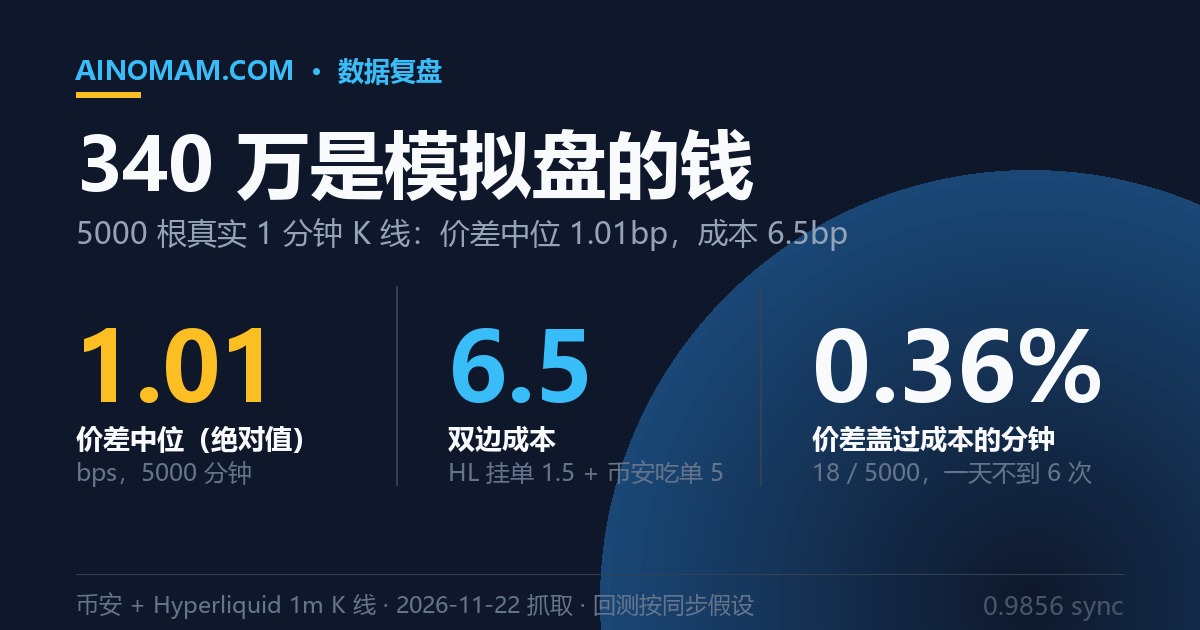
A viral post claims an 18-year-old turned three free repos into $3.4M. It was a simulator. Measured correlation between the two venues is 0.9856, median spread 1bp against 6.5bp in costs.
📜 Table of Contents
📖 Keep reading
On November 17 a post went viral on X: four students made $8 million at a Jane Street hackathon, the winning code was open sourced, and three free repos are all you need to replicate it.
In the same thread, one reply got pushed to the top: The viral "$8M" was simulator money.
That line disappeared on the way to Chinese social media. $8M became $3.4M, four students became one 18-year-old.
What sits between a simulator and a live order book is the only part worth studying. I pulled 5,000 one-minute candles on ETH perpetuals from Binance and Hyperliquid and ran the fast-vs-slow arbitrage myself.
Three testable claims
The story contains three claims that data can settle:
1. Hyperliquid updates slower than Binance, so you can quote on the slow venue and wait for it to catch up.
2. The cross-venue spread is wide enough to cover fees.
3. If it works in the simulator, it works live.
All three true and the strategy stands. One false and it does not.
Setup
Data: Binance ETHUSDT perpetual (fapi/v1/klines) and Hyperliquid ETH perpetual (candleSnapshot), one-minute candles, 5,000 bars each, timestamps aligned minute by minute, covering 2026-11-18 to 11-22, a 3.47-day window.
One minute is the finest granularity public APIs expose. Real HFT lives at millisecond scale, where only order book data matters and public endpoints do not reach.
Strategy follows the original logic: Binance price is fair value, quote both sides on Hyperliquid at s basis points away, and hedge on Binance the moment a quote fills. Costs from published fee schedules: 1.5bp maker on HL, 5bp taker on Binance, 6.5bp round trip.
Claim 1: is Hyperliquid actually slower?
Correlation of same-minute returns between the two venues: 0.9856. Then the lagged correlations: HL lagging one minute drops to 0.0550, Binance lagging one minute 0.0410, HL lagging two minutes 0.0069.
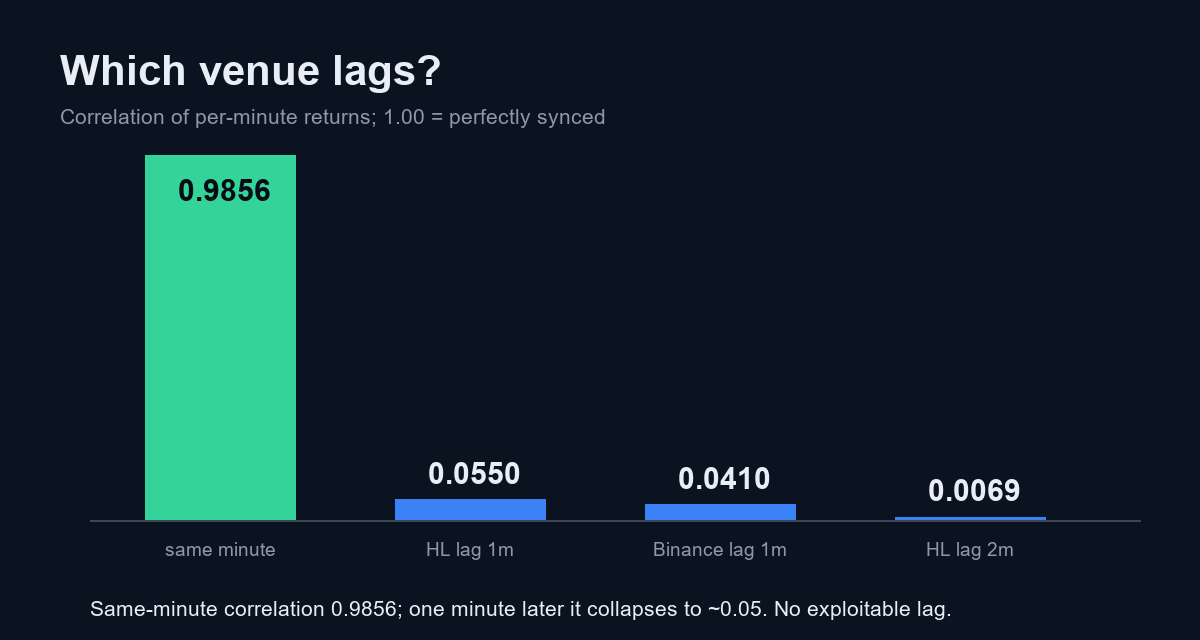
0.9856 means both venues move within the same second. One minute later correlation is essentially zero, so the lag is far shorter than a minute and invisible at this granularity.
Exploiting it requires millisecond execution against colocated, FPGA-driven market makers.
Claim 2: does the spread cover the cost?
Across 5,000 minutes, Hyperliquid close minus Binance close: mean -0.36bp, median -0.39bp, median absolute spread 1.01bp.
Quantiles: p90 1.63bp, p95 2.27bp, p99 3.89bp, p99.9 just 6.31bp, max 9.57bp.
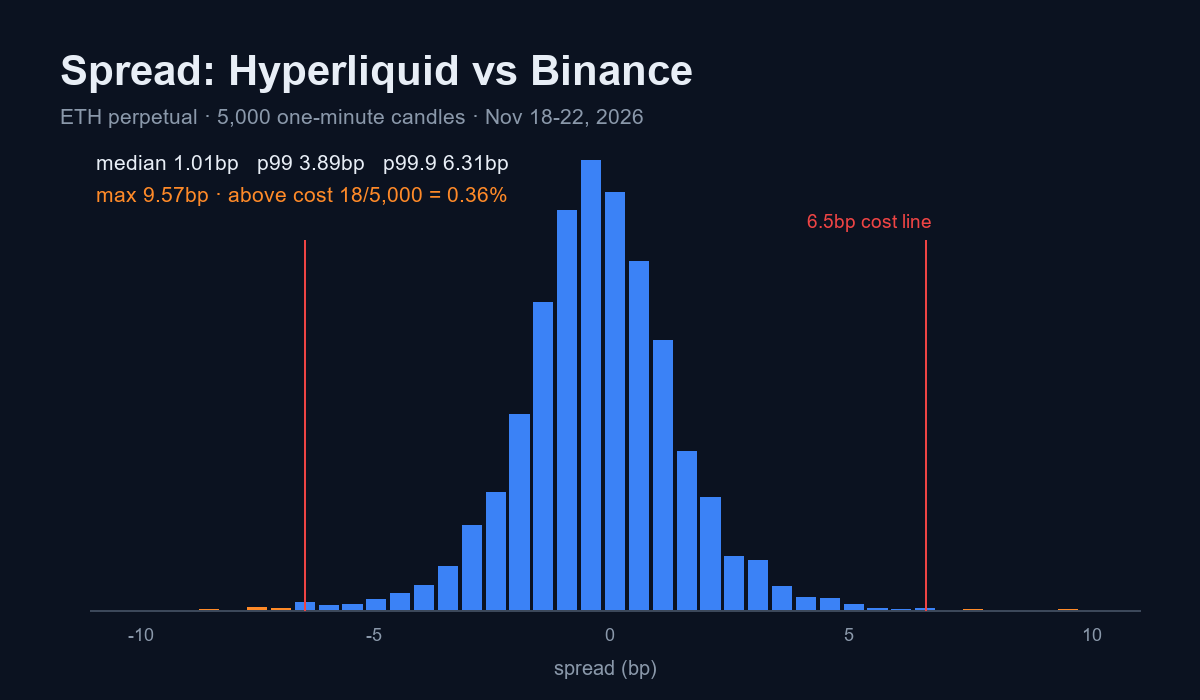
The cost line is 6.5bp. Minutes where absolute spread exceeded it: 18 out of 5,000, or 0.36 percent, roughly 5.2 times per day.
For 99.9 percent of the time the spread does not even cover fees. The 18 minutes that do clear it are fewer than six a day and indistinguishable from post-fill noise.
Claim 3: does the backtest make money?
My first pass showed a 100 percent win rate and $4,242 to $9,241 over 3.47 days. That result was wrong. I priced the hedge at the Binance open of the fill minute, which assumes Binance is still sitting on the previous close while HL trades through the quote. With a 0.9856 correlation, that assumption cannot hold.
Recomputed under a synced assumption: at the moment of the fill, Binance has already moved to the same price, hedge PnL is roughly zero, and the trade nets -6.5bp.
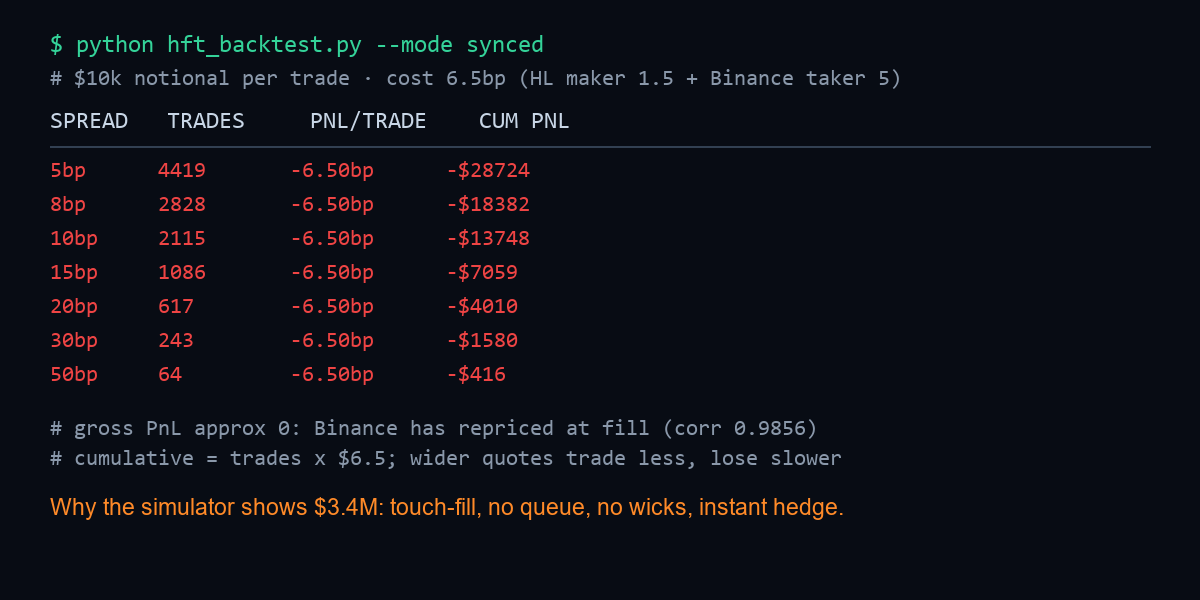
Push the quote to 50bp out and only 64 fills happen in 3.47 days, each still -6.5bp, minus $416 cumulative. Wider quotes simply trade less and lose more slowly.
Why the simulator shows $3.4M
Three assumptions that cost real money in production:
1. Touch equals fill. A simulator fills whenever price touches your quote. Live, you queue behind everyone at that price, and a wick that touches your level leaves you at the back of the line.
2. No slippage. Simulators fill at your quote. On a wick, the actual fill can be several basis points worse, wiping out dozens of trades at once.
3. Instant hedge. Simulators book the hedge. Live, an order takes tens of milliseconds, and the market can move against you in that window.
None of the three costs anything in a simulator, so every quote appears to earn its premium. All three cost money live, and the premium itself is about one basis point.
When it does work
It is not impossible, it just needs different conditions:
1. Speed. Colocated deployment, two-sided quoting, sub-millisecond cancel latency. That is market making, not three repos and an AI coding assistant.
2. Inventory. Cross-venue arbitrage means holding both legs. When one fills and the other does not, you carry exposure and need inventory rules and forced hedging.
3. The right market. New listings, thin books and few market makers produce wide spreads. On ETH perpetuals, professional desks flattened the spread years ago.
4. Full cost accounting. Beyond fees: funding, withdrawal, slippage, latency.
Reproduce it
# Hyperliquid keeps only the latest 5,000 one-minute candles
curl -s -X POST https://api.hyperliquid.xyz/info \
  -H 'Content-Type: application/json' \
  -d '{"type":"candleSnapshot","req":{"coin":"ETH","interval":"1m","startTime":1792000000000}}'

# Binance perpetual 1m
curl -s "https://fapi.binance.com/fapi/v1/klines?symbol=ETHUSDT&interval=1m&limit=1500"

# Align timestamps, compute (hl_close - bn_close) / bn_close * 10000
# Check the quantiles against 6.5bp before writing any strategy code
The point is not the number you get. Compute the cost line first, then check whether the spread distribution clears it. Ten minutes of work that saves every hope you would otherwise build.
Conclusion
The most valuable line in that viral thread was the reply: the $8M was simulator money.
A simulator validates logic, not fills. Spread, queue position, slippage and latency are free in a simulator and cost money live.
On ETH perpetuals the two venues already correlate at 0.9856, with a median spread of 1 basis point against a 6.5 basis point cost. The early edge is not "still there for the taking." It was taken long ago.
Sources: Binance fapi klines and Hyperliquid candleSnapshot, pulled 2026-11-22, 5,000 one-minute candles each. Fees from published schedules (HL maker 0.015%, Binance USDT-M taker 0.05%). Backtest assumes synced execution and excludes funding and withdrawal costs. Technical post-mortem, not investment advice.
Written by our editorial team; tools listed here are tested or verified against public sources. Links point to official sites or GitHub repos for reference only — no paid placements.