73 of 75 Multiple-Choice Items Answered Without Reading
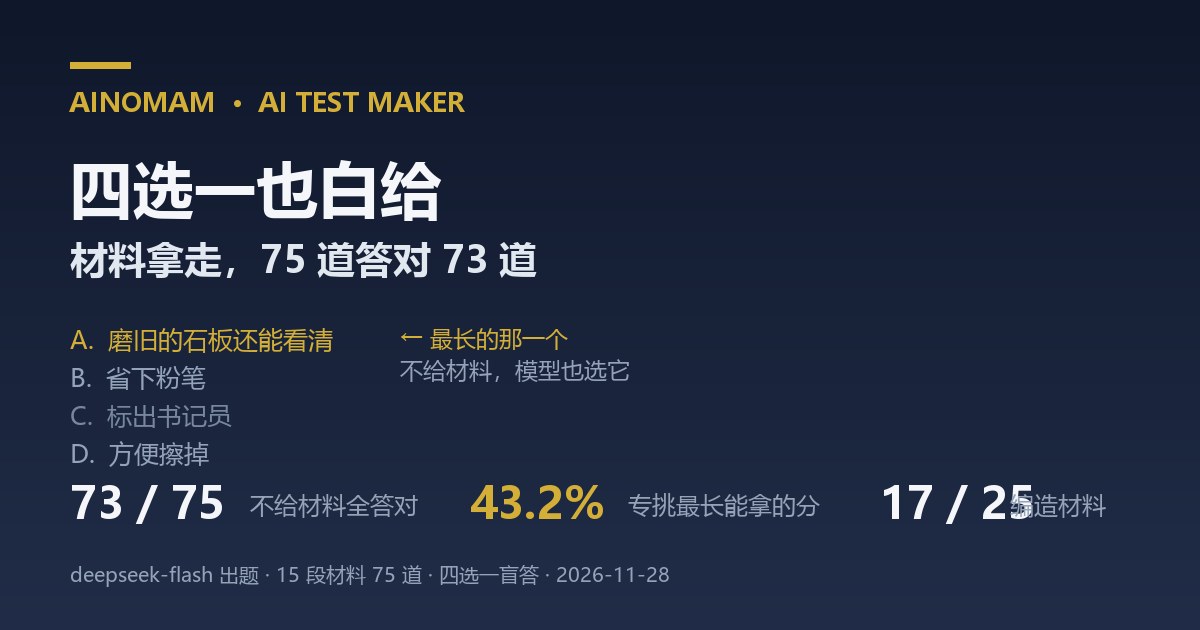
A four-option quiz from an AI test maker grades itself and looks rigorous, but the right answer is usually the longest option, and a model that never sees the passage still scores 97%.
📜 Table of Contents
📖 Keep reading
Multiple choice is the format most AI test makers lead with, because it grades without a human. It is also the easiest format to beat without reading: the correct option tends to be the longest, and the three distractors tend to be wrong in ways that are visible from the options alone. This run measures both on the same items, then tests the one-line prompt fix that is supposed to remove the length cue.
What was run
- Fifteen passages, ten English and five Chinese, the same corpus as the cloze run and the matching run: sourdough, ice cores, cable stays, espresso, 点茶, 酱油.
- Five items per passage, four options each, exactly one correct, three distractors at similar difficulty, every option under twenty words. Seventy-five items per prompt.
- Two prompts. Arm A is the plain one. Arm B adds a single line: all four options within two words of each other in length, and the correct option never the longest.
- deepseek-flash, temperature 0.8, thinking disabled, 2026-11-28. Thirty generation calls in 13.2 seconds, 7,851 input and 8,649 output tokens for both arms, 56 output tokens per item.
Seventy-three of seventy-five without the passage
Take the passage away, keep the five stems and their options, and ask for one pick per item. The model answered 73 of 75 correctly, 97.3%, with a 95% interval of 90.8 to 99.3. English was 49 of 50, Chinese 24 of 25.
That number on its own proves less than it looks, so two confounds were checked.
The first is key position. In arm A the correct answer sat in the first slot in 58 of 75 items, 77.3%, and in the fourth slot zero times. A student who always picks the first letter scores 77.3% without reading a word. The blind pass is not that: on the 17 items whose key was elsewhere, the model picked the right option 17 times out of 17, and the pick moved with the key. It was judging option content, not the letter. The position skew is a separate defect, measured on 144 items in the position-bias run; today it means any blind score has to be reported next to the always-first baseline.
The second confound is prior knowledge. Sourdough and espresso are things a model already knows, so a blind answer can come from memory rather than from the options. Five passages were written for this check describing processes that exist nowhere: a Kelbrant silicate bath, Verrin tally slates, a moraine drying loft, a two-bath Tessel dye, a calder notch gauge. Same prompt, same model, twenty-five items. The blind pass scored 17 of 25, 68.0%, interval 48.4 to 82.8, well below the 97.3% on real passages and still far above the 25% that four options allow by chance.
Read the two numbers together: part of the leak is the topic, and part is the way the options are written. The invented passages removed the memory route and two items in three were still answerable.
An example from the invented set, passage withheld. The stem asks why the crossing stroke in a Verrin stack was made thinner than the tally strokes. The options: so a worn slate could still be read; to save scarce chalk; to mark which clerk made the stroke; so it could be erased more easily. Three of the four are wrong for reasons that need no knowledge of slates — chalk saving, clerk marking, erasing. The one option left describes a legibility problem, and that is the shape the whole set takes.
| measure | A, plain prompt | B, equal-length line |
|---|---|---|
| correct option at maximum length | 64.0% | 80.0% |
| correct option the unique longest | 30.7% | 21.3% |
| score from picking a longest option | 43.2% | 42.6% |
| longest minus shortest option | 2.05 words | 1.16 words |
| key at position A | 77.3% | 92.0% |
| output tokens per item | 56.3 | 59.0 |
The length cue is worth 43 points
Measured on the same 75 items. The correct option was the longest in 64.0% of items and the unique longest in 30.7%. Rank order runs 64.0% first, 21.3% second, 8.0% third, 6.7% shortest. Mean length of the correct option was 6.51 words against 5.67 for the three distractors, a gap of 0.84 words.
A student who picks a longest option at random, splitting credit when options tie, scores 43.2% on these items against the 25% chance line, interval 32.1 to 53.9. Picking the shortest scores 14.8%, so the cue points one way only. In Chinese the same strategy scores 65.0% on 25 items, interval 44.5 to 79.8; in English 32.3% on 50. The Chinese items concentrated the cue, the English ones mostly did not.
The one-line fix that moves nothing
Arm B carries the instruction most guides recommend: equal option length, correct option never the longest. It compressed the spread, mean longest-minus-shortest falling from 2.05 words to 1.16, and it pushed the cue into ties. The unique longest dropped from 30.7% to 21.3%, items with all four options the same length rose from 9 to 17, and the correct option still sat at the maximum length in 80.0% of items, up from 64.0%.
Because ties now split the credit, exploitability did not move: picking a longest option at random scores 42.6% in arm B against 43.2% in arm A, for 4.8% more output tokens per item.
That is the trap in the naive check. The share of items where the answer is the longest option goes from 64.0% to 80.0% and reads as the fix backfiring, while the score a student actually collects stays flat. The check has to divide credit by the number of tied longest options; without that division, an instruction that did nothing looks like it failed, and one that hid the cue inside ties looks like it worked. A second trap sits beside it: arm B moved the key into the first slot in 69 of 75 items, 92.0%, so position got worse while length stayed put.
Three checks, thresholds taken from this run
For a quiz meant to test whether the passage was read, the gate is cheap. All three checks run after generation and none needs a human.
- Blind pass. Strip the passage, send stems and options to a second model, count how many items it answers correctly. Above 40% the quiz is measuring topic knowledge, not the text. Measured cost: 375 prompt tokens and 14 output tokens per batch of five items.
- Length. Compute the expected score of picking a random longest option, credit divided by the number of ties. For four options the threshold is one third. This run: 43.2% plain, 42.6% after the instruction.
- Position. No letter above 35% of items. This run: 77.3% in the first slot; the shuffle that fixes it is in the position-bias run.
Applied here, check one deletes 73 of 75 items. That is not a reason to skip the check, it is the answer the check exists to give. Items written from a passage a student has just read should fail the blind pass, and AI test makers do not produce them by default. The invented-passage control is the lever: when the passage held details that existed nowhere else, the blind score fell 29 points. What needs fixing is the passage and the stem; a line about option length does not touch it.
Where the free ceilings of the tools themselves sit is in the limits of nine free quiz makers, measured the same way.
| format | answered with the passage withheld |
|---|---|
| matching, 75 pairs (11-27) | 75 / 75 |
| true or false, 240 items (11-23) | 237 / 240 |
| four-option multiple choice, 75 items (this run) | 73 / 75 |
| cloze, 90 items (11-25) | 70 / 90 |
| four-option multiple choice, invented passages, 25 items | 17 / 25 |
What this does not show
- One model, one evening, 75 items per arm and 25 in the control. Intervals are in the text; the Chinese length-cue figure rests on 25 items.
- The blind judge is the same model that wrote the items. Shared style is a real advantage and would inflate the score; a second vendor would be the cleaner test and was not run.
- No student sat these items, so nothing here says how a class would score, only what can be answered with the passage removed.
- Items were not difficulty-labelled and not checked for a single defensible answer. Both are separate gates in this series.
- Costs are API tokens at one provider's list price, not a subscription quote from any test maker.
Written by our editorial team; tools listed here are tested or verified against public sources. Links point to official sites or GitHub repos for reference only — no paid placements.