AI Test Maker: 18 of 90 Items Repeat on a Re-run
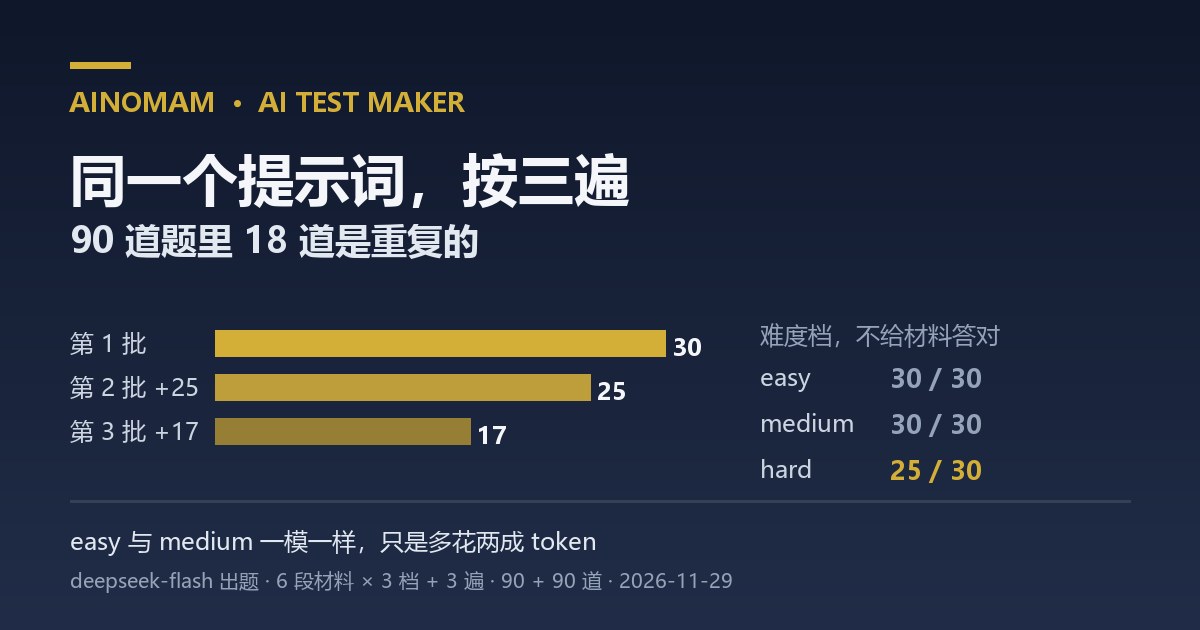
An AI test maker offers easy, medium and hard plus a regenerate button. Medium behaves like easy at 20% more tokens, and a third pass mostly returns questions you already have.
📜 Table of Contents
📖 Keep reading
An AI test maker has two promises baked into its interface: a difficulty dial with easy, medium and hard, and a generate button you can press again when the first batch is not enough. Both were measured on the same six passages, with the passage taken away for a blind pass afterwards. The dial moves the stem and the token bill more than it moves the answer. The generate button stops paying sooner than most people expect.
What was run
- Six passages from the shared corpus, the same texts as the cloze run, the matching run and yesterday's four-option run: four English texts of 120 to 133 words (sourdough, ice cores, cable stays, honey crystallisation) and two Chinese texts of 167 and 179 characters (点茶, fibre dispersion).
- Label arm: every passage asked three times, once per label, five four-option items each, ninety items total.
- Repeat arm: every passage asked three times with a byte-identical prompt, five items per batch, ninety items total.
- Blind pass on every label batch: passage removed, one pick per item. deepseek-flash, temperature 0.8 for generation, 0.0 for the blind pass, thinking disabled, 2026-11-29. Fifty-four calls, 16,260 input and 11,266 output tokens, 15.0 seconds.
What the label changed
| label in the prompt | items | answered blind | output tokens / item | stem words | key in slot A |
|---|---|---|---|---|---|
| easy | 30 | 30 (100%) | 50.3 | 6.3 | 26 (86.7%) |
| medium | 30 | 30 (100%) | 60.6 | 6.4 | 23 (76.7%) |
| hard | 30 | 25 (83.3%) | 81.1 | 10.9 | 19 (63.3%) |
Two of the three rows are identical where it counts. Easy and medium both scored 30 of 30 on the blind pass, 100% each with a lower bound of 88.6 at 95%. Their stems came out the same length, 6.3 and 6.4 words. The only thing medium bought was 20% more output tokens, 60.6 per item against 50.3.
Hard behaves like a different setting. The blind score fell to 25 of 30, 83.3%, interval 66.4 to 92.7. Stems grew to 10.9 words, from 6.3 and 6.4 in the other two rows. The question openers moved from what and how to which, according to and why: thirteen of the twenty English hard stems open with one of those three, against three of twenty easy ones, and seven of the ten Chinese hard stems open with a phrase pointing back at the passage (根据, 材料, 关于) against none of the easy ones. Output cost went to 81.1 tokens per item, 61% above easy.
Pooled across the three labels, 85 of 90 items were answered with the passage withheld, 94.4%, interval 87.6 to 97.6. A hard item is a longer question about the same passage, and the passage is still not needed to answer it.
Three identical prompts, ninety items, seventy-two unique
| passage | items generated | unique after dedupe | new in batch 2 | new in batch 3 |
|---|---|---|---|---|
| sourdough | 15 | 11 | +5 | +1 |
| ice core | 15 | 15 | +5 | +5 |
| cable stay | 15 | 10 | +3 | +2 |
| honey | 15 | 10 | +4 | +1 |
| 点茶(167 字) | 15 | 12 | +4 | +3 |
| 光缆色散(179 字) | 15 | 14 | +4 | +5 |
| total | 90 | 72 | +25 | +17 |
Eighteen of ninety items were repeats: thirteen with an identical stem and five near-misses at five-gram overlap of 0.5 or more, such as What do the yeasts in a starter produce? against What gas do the yeasts in a starter produce?. English repeated more than Chinese, 23.3% against 13.3%, which tracks how much room a 120-to-133-word passage leaves for factual questions.
Nothing repeated inside a single batch. All eighteen duplicates were across calls, which is the failure a regenerate button produces and the one a teacher cannot see while scrolling a new batch.
The third run is where the bank flattens
Read the batches as marginal yield. The first batch gave 30 new items, the second 25, the third 17. On the sourdough passage the third batch added one new item out of five. Honey added one. Cable stays added two. Only the ice core passage kept producing five new items in every batch.
The practical rule that falls out: two batches from a short passage are worth asking for, a third rarely is. Anything beyond that is a dedupe problem dressed as a supply problem.
What held up
All 180 generated items had four options and four distinct option texts. Zero malformed items, zero duplicate options inside a question. Option hygiene is the part that works out of the box.
Key position did not. Of the 86 items whose answer string matched an option verbatim (four of ninety did not, so position could not be counted there), 68 put the key in the first slot, 79.1% with an interval of 69.3 to 86.3. Twelve sat in B, six in C, none in D. That is the same defect measured at 77.3% in yesterday's run and on 144 items in the position-bias run: the label does not change it, and asking for hard items reduces it without fixing it, 86.7% at easy, 63.3% at hard.
Config you can copy
- Ask for five items per call. Dedupe before import: word five-grams with Jaccard at 0.5 for English, eight-character shingles for Chinese, both counted on the stem only.
- Use the difficulty label only when you need longer stems or inference-shaped questions. It costs 61% more output tokens than easy and still leaves five items in six answerable without the passage.
- Expect the third batch to add under twenty new items per thirty. Plan the bank size around two batches plus dedupe.
- Shuffle options after generation and check no letter carries more than 35% of the keys. This run: 79.1% at A before shuffling.
The reading-level dial is a different axis with its own numbers, measured in the grade-dial run; the tool-side ceilings are in the free quiz maker comparison.
What this does not show
One model, one temperature, six short passages, thirty items per label. The easy-to-hard gap is directional at that sample size, not a calibration curve. The blind judge is the same model family that wrote the items, which inflates every blind score here. No student has sat either set. The duplicate threshold of 0.5 is a choice; at 0.7 the eighteen repeats fall to fifteen, and a human reading both batches would find more than either count.
Written by our editorial team; tools listed here are tested or verified against public sources. Links point to official sites or GitHub repos for reference only — no paid placements.