Best AI Test Maker for Special Education Teachers, Measured
An AI test maker gives a special education teacher forty probe items a week and calls it done, while the reading level quietly lands two grades below what was asked.
📜 Table of Contents
📖 Keep reading
An IEP goal is written in one sentence and then assessed for a school year, five probes at a time. If a case manager has eight goals in play, that is forty items a week, each one written at or below the level the student actually reads at, each one testing a single skill, none of them with the answer printed on the student copy. This is the exact workload that a test maker sells into, and it is the one place where a wrong reading level is not cosmetic: a grade-4 stem handed to a decoding student measures reading, not the goal.
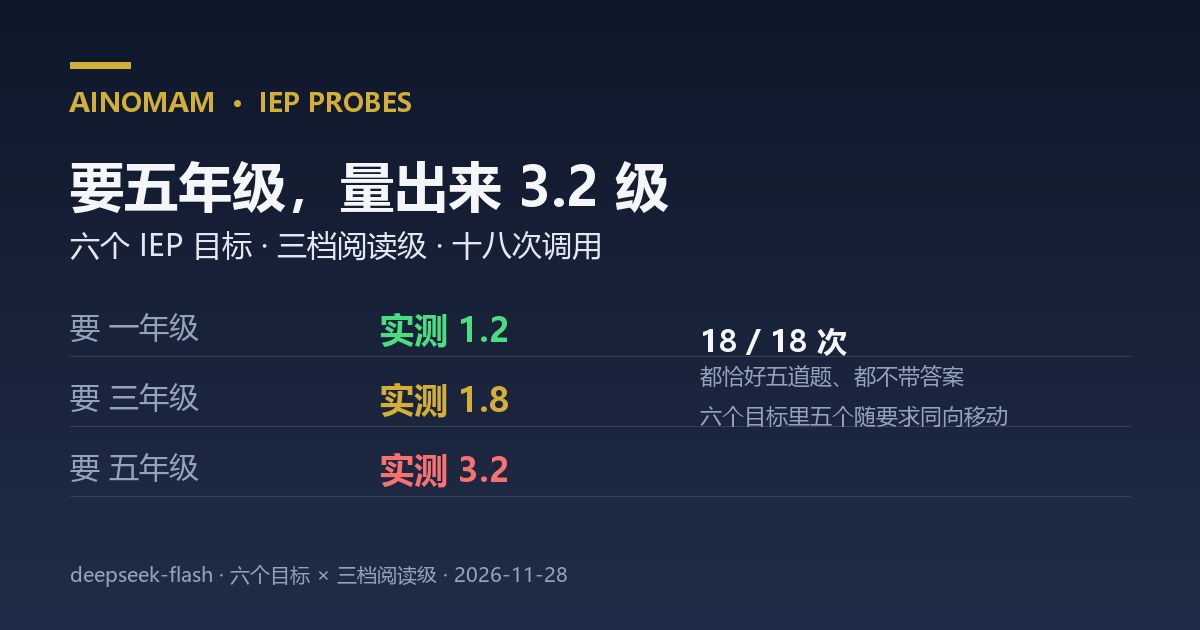
So I tested the dial rather than the interface. Six IEP-style goals, three reading levels each, five items requested per goal: eighteen calls, ninety-two items. The item count and the format held up on all eighteen. The reading level did not hold at the top: ask for grade five and the stems came back at grade 3.2.
What a probe set has to do
- Five to ten items per goal, five is the usual weekly cadence.
- One skill per item. A stem that asks the student to read the word and then explain it is two goals, and a score on it means nothing.
- Reading level at or below the student's, because a probe is supposed to isolate the skill, not the reading.
- Student copy and answer key separate, since a printable probe with the answers underneath goes home and comes back perfect.
- Repeatable: the same short shape every week, or the numbers are not comparable across September and April.
How it was measured
- Six goals across maths, decoding, counting, listening comprehension, sentence writing and main idea.
- Each goal asked three times, at Flesch-Kincaid grade 1, 3 and 5, five items each, one sentence per stem, no answer key, no multiple choice: eighteen calls on deepseek-flash, temperature 0, thinking disabled, 2026-11-28.
- Grade level computed on the stems with the standard Flesch-Kincaid formula: 0.39 times words per sentence plus 11.8 times syllables per word minus 15.59, syllables counted by vowel groups with a silent-e rule.
- Output cost of the whole run: 1,446 input tokens and 1,149 output tokens, about 64 output tokens per item.
What held: count, format, no answer key
Eighteen out of eighteen responses returned exactly five numbered items. Not one produced multiple choice options although none were asked for. Not one printed an answer key, which matters because the same prompt that says do not include answers is the cheapest way to keep the student copy printable. If any of those three had drifted, the teacher would be editing eighteen item sets by hand and the tool would have saved nothing; at 64 output tokens per item, printing is not a token problem.
That is the part of the job a generator is actually good at: volume with a fixed shape. The part it is not reliably good at is the level.
The grade dial undershoots
| grade asked for | Flesch-Kincaid of the five stems | words per stem |
|---|---|---|
| grade 1 | 1.23 | 7.5 |
| grade 3 | 1.75 | 8.6 |
| grade 5 | 3.18 | 9.6 |
Averaged over six goals, the requested level moves the answer in the right direction and lands low. Grade 1 comes back at 1.2, grade 3 at 1.8, grade 5 at 3.2. The gaps are not uniform, which is the more useful finding:
| IEP goal | asked grade 1 | asked grade 3 | asked grade 5 |
|---|---|---|---|
| compare two numbers to 20 | 2.9 | 2.9 | 2.8 |
| read CVC words aloud | -2.2 | -1.4 | 0.8 |
| count objects to 20 | 0.9 | 1.8 | 2.7 |
| answer a who question | -1.0 | -0.7 | 2.0 |
| write one sentence | 2.4 | 3.5 | 5.2 |
| state the main idea | 4.4 | 4.4 | 5.6 |
Five of the six goals climb with the request. The maths goal does not move at all, because its stems are built from numerals and the words which number is bigger, and no amount of rewriting that sentence raises a readability score. The decoding goal goes negative, because three-letter nonsense words are not where any readability formula was calibrated: minus 2.2 at grade 1, still 0.8 when asked for grade 5.
Two practical consequences. Ask one to two grades above the target if the target is middle school, and check the stems rather than trusting the label. And for goals whose stems are almost all numerals or single words, do not read the score at all: Flesch-Kincaid on a five-word stem is arithmetic on noise, which is why the numbers in the table swing from minus 2.2 to 5.6 across goals that a teacher would call similarly easy.
The one place the undershoot is unambiguous is where it hurts most: grade 5 request, 3.2 measured on sentence writing and main idea, both of which produce long stems where the formula is at least stable.
Which item format earns a place in a probe
The format question is settled by earlier runs in this series, and it points away from two of the four formats a test maker offers first. A matching set was recoverable at seventy-five of seventy-five pairs with the passage withheld: it measures whether the term is already known, so it cannot certify that the student read anything, as the blind pairing run shows. True or false items kept 237 of 240 answers with the passage removed, which makes them a vocabulary check in disguise, detailed in the no-reading run.
Cloze is the only format that partly requires the text, 70 of 90 answers survive without it, because a blank is selected by the sentence rather than by the term, as in the cloze run. Short answer, the format measured today, has no options to guess and no passage to lean on, which is why it is the right default for a probe even though it is the format generators handle least elegantly.
What to ask a free tier before you commit
- Can it be told the reading level explicitly, in grades, and does it show the level it used? If the level is a slider with no output check, today data says assume a two-grade miss.
- Does it return exactly N items when asked for N? Eighteen of eighteen did here, which is the baseline; anything less means hand editing.
- Is the answer key a separate output from the student copy? A single block with answers underneath is not printable.
- Can you state one skill per item, or does it bundle a read-and-explain item? Bundled items cannot be scored against a single goal.
- What does 100 items cost? At 64 output tokens per item on this model, an item is a fraction of a cent, so a tier that caps you at twenty items a month is charging for the interface, not the inference.
Where the free ceilings of the tools themselves sit is in the limits of nine free quiz makers, measured the same way.
What this does not show
One model, one evening, six goals I wrote, no students. No probe was administered, so nothing here says whether the items discriminate between a student who has the skill and one who has not, which is the only test that matters for an IEP. Flesch-Kincaid is noisy on stems this short and is not a substitute for a teacher reading the item. And no commercial test maker was driven through its interface: the measurements are of the generation step, which every one of them wraps.
Four numbers to take away: 18 of 18 item sets came back at exactly five items with no answer key, 3.18 was the measured grade when five was requested, five of six goals moved in the right direction with the request, and 64 output tokens per item is what the volume costs. The format evidence behind the short-answer recommendation is in the matching, true-false and cloze runs linked above.
Written by our editorial team; tools listed here are tested or verified against public sources. Links point to official sites or GitHub repos for reference only — no paid placements.